A vote that really counts
Politics is broken in Canada, writes Andrew Coyne. But B.C. could help fix it next week.
Dear British Columbia:
I know you’re kind of busy right now, and maybe it’s not my place, being from another province and all, but could I just ask you, on behalf of the rest of the country, to please vote Yes in the May 12 electoral reform referendum? I wouldn’t intrude, except it’s terribly important—important not just for B.C., but for all of us.
Because politics is broken in Canada, and electoral reform—changing the way we vote—may just be the key to fixing it.
B.C., you hold that key in your hands. If the referendum passes, it will not only transform the politics of your province, it will put electoral reform squarely on the map for the country as a whole. Whereas if it fails in B.C.—after the failure of reform efforts in Ontario, Quebec and P.E.I.—it may be the last we’ll see of it for some time.
By now you’re probably familiar with the broad outlines of the debate. Under the old system, in use federally and in all 10 provinces, you mark an X beside the name of the candidate of your choice, and whomever gets the most votes in each riding wins. Hence its popular name: “first past the post.” If you don’t mind, I’ll shorten that to FPTP.
Under the proposed new system—recommended after months of study and debate four years ago by the B.C. Citizens Assembly, a group of randomly selected men and women from across the province—you’ll instead rank your favourite candidates in order of preference: 1,2,3, and so on. And in place of today’s single-member ridings, each riding will elect several members. (Of course, that means there’ll have to be fewer, larger ridings, to keep the legislature from exploding.)
Who gets in? You start by counting up the first choices. Then, as candidates are either eliminated from contention or assured of election, voters’ second choices are redistributed among the remaining contenders. And then their third choices, and so on. (It’s a little complicated, but that’s the returning officers’ problem, not yours. All you need to know is 1, 2, 3 . . .) That’s why it’s called the single transferable vote, or STV.
Why does this matter? Here’s why: under the current system, the candidate with the most votes wins, no matter how few he gets. In a typical six- or seven-person race, candidates often win with as little as 30 per cent of the vote. But that candidate and his followers then get 100 per cent of the power to represent that riding.
What’s true for a single riding is even more true in the aggregate. Under FPTP, governments routinely win “majorities” with 35 or 40 per cent of the vote. Sometimes they even win a majority of the seats with fewer votes than their rivals: that’s how Glen Clark won B.C.’s 1996 election over Gordon Campbell. And sometimes a party will take nearly all of the seats with little more than half of the vote: that’s how Campbell was able to rule all but unopposed after 2001.
Under STV, by contrast, the power to represent a riding is shared. Say it’s a five-member riding: if a party gets 20 per cent of the vote, it gets 20 per cent of the representation, or one member; a party that gets 40 per cent of the vote would get two members. Again, the same is true in the aggregate: a party’s representation in the legislature will tend to be proportional to its share of the vote. STV is a form of “proportional representation”—PR for short. (I promise that’s the last acronym.)
Well, so what? So the parties’ share of the seats don’t always precisely mirror their share of the vote. It may be a little unfair, but whoever said life was fair? It works, doesn’t it?
No. We’ve only just begun to describe the problems with the present system. So if your view of this tends to the “if it ain’t broke, don’t fix it” end of things, let me try to convince you: it is broke.
Let’s just revisit that fairness question, for starters. The issue isn’t fairness for parties. It’s fairness between voters. Take the last federal election (just to broaden this out from B.C. a little). The NDP, with 2.5 million votes, won 37 seats, meaning it took roughly 68,000 NDP votes to win one seat. Meanwhile the Bloc Québécois, with 1.4 million votes, took 49 seats: about 35,000 votes per seat won. So, quite literally, one BQ vote was worth two NDP votes.
This is pretty fundamental. If there is a bedrock principle of our democracy, it is supposed to be one person, one vote. Every vote is equal, and every vote counts. Yet that is simply not the case in Canada today. Indeed, if you’re a Green voter, your votes might as well not have been counted at all: 938,000 Green votes were worth exactly zero seats.
Well, the Greens. What’d they get: seven per cent of the vote? Except it isn’t just Green voters who are disenfranchised in this way. The same is true of any voter in any riding who supports any other candidate but the winner. In most ridings, that’s most of the voters. Strange but true: in a typical Canadian election, over half the votes . . . don’t count.
And of course, even if you do happen to vote for the winning party, that doesn’t necessarily guarantee effective representation—if you live in a “safe” seat, or indeed a safe region, such as FPTP tends to produce. Since only the leading candidate in each riding gets in, a party that can bunch its votes geographically, like the Bloc, will do relatively better than a party whose vote is spread more evenly, like the Greens. Parties that take a narrow, regional view are thus rewarded at the expense of parties with a broader, national perspective. Politics divides along regional lines, rather than along ideological differences. In place of debates, we get grievances. Sound familiar?
The result is a highly distorted picture of the country. To look at Parliament, you would think there were no Liberals in Alberta, no Conservatives in Toronto—and that federalists were the minority in Quebec. Add to this the phenomenon of vote-splitting, which further limits voter choices: rather than simply vote for the party they like, they are forever being told they must vote against the party they dislike. Anyone who might think of starting a new party, out of dissatisfaction with the choices on offer, is likewise told not to bother: after all, they will only “split the vote.”
By now you may be suspecting this is about much more than the way we count the votes, and of course you’re right. The case for electoral reform isn’t only about what happens on election day—it’s about what happens every day in between. And this is really how we should think about FPTP: not just in terms of the distortions and anomalies it produces, but the incentives these present the political players—the rewards and penalties that accrue, depending on what strategies they choose. In essence, FPTP is a highly leveraged system: a two per cent swing in the popular vote can result in a much larger change in relative seat counts. In that tiny sliver of the vote can hang the difference between a majority government for one party, or a majority for the other.
Much of what we deplore in our politics can be seen in this light. Faced with such massive down-side risk, politicians are inclined to play it safe—very safe. Hence the parties tend to hug as close to each other as they possibly can, minimizing their policy differences while attacking each other in stridently partisan terms. Only at election time do they take off the wraps; in the concentrated time frames that our campaigns allow, that typically means the sorts of wedge-issue gimmicks that can be reliably expected to yield small gains in the short term. Because a small gain is all they need.
How would PR—STV, in particular—change all this? In every conceivable way. Under STV you’d have a much better chance of actually electing someone in your riding who represented your point of view: not only supporters of the leading candidate would get representation, but also second and third parties. In fact, because second and third choices, even for last-place candidates, are redistributed, everybody’s vote would count. There would be less reward to vicious partisanship: candidates would hesitate to offend each other’s supporters, for fear they might need them on later ballots.
If everybody’s vote counted, there would be fewer safe seats, or regional ghettoes: since every riding would offer a potential gain or loss of at least a member or two, every riding would be contested—and not only among the established parties. New and small parties would now stand a fighting chance. No longer could the fear of splitting the vote be used to terrorize voters into line: a vote for a new party need no longer be considered wasted.
Among proportional representation systems, STV is noteworthy for the way in which it preserves the local representation that is the most cherished feature of our existing system. Indeed, with multiple members in each riding, voters will benefit from competition to represent their concerns, even between elections.
Moreover, given the chance to rank their choices rather than mark a single X, voters will no longer face the Hobson’s choice that so often bedevils them at present: between the candidate they like, running for a party they despise, and the candidate they loathe, running for the party they support. They can vote the party line with most of their choices, but also give a nod to a particularly ?ne independent or rival party candidate. And that means greater autonomy for candidates from the parties—with enough second and third choices, a candidate can get elected even without the bosses’ blessing.
It’s true, as opponents point out, that PR would make majority governments unlikely, given how rarely a party wins more than 50 per cent of the vote. But would it really? It would certainly make one-party majorities less likely. But nothing would prevent the formation of stable multi-party majorities—real majorities, that is, not the phoney ones we have today—as is the norm in the dozens of countries around the world that use some form of PR. In this sense, reform would not mean the end of majority government, but the beginning of it.
We think of minority governments as unstable because, in our present winner-take-all system, they are: the payoff from that two per cent swing is such that every party has its finger poised over the election button, ready to press it the minute they get a pop in the polls. But take away the leverage—let a two per cent swing in the popular vote mean a two per cent change in seats—and everyone is forced to calm down. Politics becomes more incremental, a matter of long-term persuasion, rather than short-term gambles.
Indeed, many of the most common criticisms of PR could better be applied to FPTP. Instability? That would well describe the changes of government Ontario endured in recent elections, from Bob Rae to Mike Harris to Dalton McGuinty. Or if the concern is that fringe parties, representing a tiny fraction of the population, might wield disproportionate influence—well, what do you call the parties’ obsession, under the existing system, with that sliver of the electorate known as “swing voters,” on whose every whim their fortunes depend?
So you see, B.C., it all comes down to you. If there’s anywhere electoral reform is most desperately needed, it’s probably in federal politics: the damage FPTP has done, particularly in terms of regional ghettoization, is most acute there. But reform is most likely to occur at the provincial level first. And that means you. You came so close in 2005, when you voted 58 per cent in favour of reform—just shy of the required 60 per cent margin. If it’s ever going to happen, B.C. is the place. And now is the time.
So come on B.C. Pluck up your courage. Show us the way. Light a candle for electoral reformers everywhere. We’re depending on you.
Your friend,
Andrew
cc The Rest of Canada
Showing posts with label proportional representation. Show all posts
Showing posts with label proportional representation. Show all posts
Thursday, May 7, 2009
Andrew Coyne: Where the hell have you been?
So Andrew Coyne wrote an open letter to British Columbians in Maclean’s magazine that gives a very persuasive argument about the problems with first past the post and how it leads to so many problems with politics, in general, that have disenfranchised voters. I say: A) Well said and I completely agree, and B) What the F%$# took you long? Do you have any idea how difficult it’s been to campaign out here and to get anybody of any stature to say anything positive about BC-STV on a medium that has any reach? Why the hell did you have to wait until the 11th hour to speak up? Sheesh.

Tuesday, April 7, 2009
Nice objective piece on BC-STV by the CBC
There was a nice backgrounder on the CBC website that gives a good, neutral take on BC-STV and how it came to be recommended by the Citizens’ Assembly. It’s a good place to start for people who are unfamiliar to BC-STV (although stv.ca is probably an even better place to start, this is a pretty good option too) as it has accompanying links to external sites that are pertinent to the subject.
B.C.'s referendum on proportional representation
Is it time for a new electoral system?
Monday, April 6, 2009 By Mike Laanela, CBC News
For the second time in four years, B.C. voters will be casting a second ballot during the provincial election that could fundamentally transform the way we choose our provincial politicians.
Along with voting for their local MLA, voters will be asked to decide if they want B.C. to adopt a new proportional representation electoral system that would change how ridings are organized and MLAs are elected. Proportional representation is also known as the single-transferable-vote system, which in B.C. has been dubbed BC-STV for short.
Currently, B.C. is divided into 85 ridings, including six new ones created for this election. Voters living in each riding elect one candidate to represent them as a Member of the Legislative Assembly, known as an MLA.
This system is called first past the post, because only one candidate in each riding gets elected. It is the same system used to elect members of Parliament in Ottawa and the provincial representatives in every other province in Canada.
Several years ago, the province created a Citizens' Assembly to study the electoral system and determine whether there might be a better option for B.C.
In 2004, the assembly recommended that B.C. switch to a new proportional electoral system.
What is BC-STV?
The new system is very different from the current one in four main ways.
First, the number of ridings would be reduced from 85 smaller ones to 20 larger ones, known as electoral districts.
Second, instead of electing just one MLA in each riding, the voters in each electoral district would elect two to seven members to the Legislative Assembly.
The exact number of MLAs in each district would be determined by its size and total population. Large rural areas might only have two MLAs while smaller, densely populated urban districts might have as many as seven MLAs.
In simple terms, if there were five seats in a riding, the five candidates with the most votes would be elected as MLAs.
That would mean that candidates from parties that don't usually get enough votes to win a seat, such as the Green Party, have a better chance of getting elected, and that more than one member from a popular party, such as the BC Liberals or the NDP, might be elected in one district.
Because of that, the overall results would better reflect how people voted, according to the members of the Citizens' Assembly.
Transferring votes
The third way the system would change would be in the way people vote.
Instead of marking an X beside one name, voters would rank candidates from most favourite to least favourite, by writing 1, 2, 3, 4, etc., right on the ballot.
The fourth change would affect how the votes are counted. This is the most complicated part of the STV system.
Candidates would need a certain number of votes to be elected, based on the number of MLAs the district is electing and the number of people who vote.
If no candidate receives enough votes to be elected, the candidate with the fewest votes is eliminated from the counting, and all of the votes for that person are then distributed to the next choice on each ballot.
The votes are then recounted to see if any candidate has enough votes to win.
The process continues with the lowest candidate being eliminated and his or her votes being transferred to the next choice on the ballot until all the required candidates are chosen to represent the district.
No more 'wasted' votes
The counting system gets more complicated during the counting of the votes if a candidate gets more votes than the exact number they need to be elected.
If that happens, the so-called extra or surplus votes are redistributed to the next choice on the ballots.
But in order to be fair, everybody who voted for the winning candidate has their vote redistributed but only a fraction of each vote is transferred, based on how many extra votes the winning candidate had.
The reason for this is so that everyone's extra vote gets counted and no vote is ever wasted, according to those who designed the system.
In order to keep track of the thousands of calculations this would require, computers would be used to count the votes in the elections.
Why change?
There is much debate about how well the new system would work and what sort of results it would produce.
Critics of BC-STV have several complaints about the system.
Some say it is too complicated for people to understand how their vote will be counted, and therefore it may make the voting process confusing.
Critics also say the BC-STV system been unproven in real life situations, and other countries with similar systems have had trouble with the results.
They also say the electoral districts would be too large and voters would not know who represents them, and that while a majority government is possible, the BC-STV is more likely to produce unstable minority governments or coalitions of two or more parties.
On the other hand, critics of our current system have said it does not reflect the real choices of voters.
For example, candidates often win their seat with about 40 per cent or less of the votes, simply because they have more votes than any of the other candidates.
That means situations arise in which 60 per cent of the people, the majority of voters, did not support the candidate who was elected.
In addition, parties that might get only 10 or 20 per cent of the votes across the province never get any candidates elected because they don't have enough votes in one single riding.
This time, in order to encourage debate about the referendum, the B.C. government is funding two independent campaigns during the election, one on each side of the question. More information on the STV system can be obtained on the respective websites of the pro and con campaigns.
The second referendum
In 2005, voters in B.C. voted nearly 58 per cent in favour of adopting the new system. But according to a law passed by the government, more than 60 per cent of voters must approve the new system for it to pass.
Not only that, more than 50 per cent of the votes in at least 51 of the province's 85 electoral districts must support the change.
That's because the government believes the change must be supported by a significant majority of the population in all areas of the province to become the new electoral system.
Because the result was so close last election, but so many people said they did not understand the issue, the government decided to hold the referendum again.
There is also a neutral Referendum Information Office, with a mandate to provide objective information to voters about both electoral systems.
If B.C. voters approve the new system, by law, it would take effect in the 2013 provincial election.
Thursday, March 12, 2009
A Nice Explanation of BC-STV by Nick Loenen
I thought that this was a great article by Nick Loenen, who’s been a real driving force behind the movement for electoral reform in BC. He’s also written a book on the subject, called "Citizenship and Democracy, a case for proportional representation".
Anyways, Mr. Loenen gives a great overview of how STV works and even addresses some of the more common myths that are thrown out by its critics.
Anyways, Mr. Loenen gives a great overview of how STV works and even addresses some of the more common myths that are thrown out by its critics.
A New Voting System: How it Works
by Nick Loenen, Ladysmith Chronicle, March 11, 2009
On May 12, British Columbians will be asked if they wish to keep the current voting system or to accept a new way of electing MLAs, as recommended by the Citizens Assembly.
The assembly selected the single transferable vote, adapted it to our provincial needs and called it BC-STV. It joins existing ridings into multi-seat ridings consisting of two to seven seats. Within those larger ridings groups of like-minded voters will elect one MLA as their representative.
When filling in the ballot, voters do not select one candidate among many, but rank candidates 1, 2, 3 etc. On average, there will be fifteen to twenty names on the ballot and voters can rank as few or as many as they wish. To make it user-friendly, candidates will be grouped on the ballot by party affiliation. Many voters go only to the party box of their choice and rank one or all the candidates in that box. Voters may rank candidates from different parties if they want. Independent candidates, too, will be listed and have a very good chance of being elected for simply being good local representatives without any partisan affiliation.
What happens to all these rankings? Think of your vote as one dollar. When ballots are counted, your vote, all one hundred pennies, goes to your first choice candidate. If that candidate is eliminated for not having sufficient votes, your vote, all one hundred pennies, goes to your second choice candidate. If that candidate is elected, but with a surplus of say ten percent, it means ninety pennies of your vote have been spent and the remaining ten pennies will go to your third choice candidate. And so on, until all of your vote (pennies) has been spent. In the current system you lose all one hundred pennies if you don't vote for the single winner.
Is it possible for the more populated areas to snatch all seats? No. Each existing riding has sufficient numerical strength to elect its own MLA. The more densely populated areas cannot elect more MLAs than they are entitled to by their numbers. Each MLA goes to Victoria representing the same number of voters. To ensure nearly all voters can point to someone in Victoria they helped elect, MLA’s surplus votes are redistributed among remaining candidates according to voters’ wishes. Some MLA will need the few scattered voters in the more remote regions of the riding to get to Victoria. No area or neighbourhood will go without representation.
During the 2005 referendum, it was suggested BC-STV is too difficult. Vancouver Sun reporter Neal Hall asked voters in Ireland if they thought it difficult and found no one to support the claim. Ireland has used this system since 1921, and twice the Irish voted by referendum to keep it.
With such a large riding, is it not more work and more expensive for candidates to campaign in an election? No. Candidates do not need all the votes, just enough to fill one seat. Candidates will carefully pitch their platform to one group of voters. BC-STV establishes a very close link between each MLA and a particular group of voters. This also explains why independent candidates do get elected with BC-STV.
Nick Loenen is a former Richmond City Councillor and MLA. For more visit: www.stv.ca or contact: nick.loenen@stv.ca
Saturday, January 24, 2009
Criticism #5: BC-STV doesn’t guarantee proportional results
This is one of the more bizarre arguments thrown out by BC-STV critics and I think it's a sign of just how desperate they are if they have to resort to such ridiculous and backward thinking criticisms.
In his knowstv.ca website, Bill Tieleman tries to make the case that we shouldn’t vote to change to the Single Transferable Voting system (BC-STV) because it doesn’t guarantee proportionality:
Mr. Tieleman’s buddy, David Schreck, former MLA, adviser to Premier Glen Clark and now Secretary-Treasurer of the No STV campaign, has his own website for disseminating misinformation about BC-STV called Strategic Thoughts. In one of his essays (November 1st, 2004), Mr. Schreck presents a hypothetical situation under BC-STV where a Green Party candidate would win 10% of the vote without getting elected. Of course, he relies on this dream scenario playing out by making the assumption that out of 100,000 voters, not a single one is willing to vote outside of party lines.
A scenario that is so unlikely to the point of absurdity. Notice also how in both examples, they only look at single ridings instead looking at elections as a whole. When BC-STV supporters talk about proportionality, we're referring to the results of an entire election, not individual ridings.
Now on January 13th, 2009 during his CKNW debate with Shoni Field, Mr. Schreck actually did point to one election in Malta in 1981 where one party one more seats while the other party won more of the popular vote. But what he failed to mention was that in that election, the parties were only separated by a margin of 1.8% in the popular vote, with the seat distribution being 34 to 31, almost a tie.
No matter what electoral system is used, there’s always a risk of distortion in close races. The point is that under our current system, distortions occur even when the race isn’t close, such as when parties win 50-60% of the seats with only 40% of the vote.
The thing is if you take a step back and look at election results in Northern Ireland, the Republic of Ireland and Malta over the long term, you see that the percentage of seats a party wins is consistently around 2-3% of their share of the popular vote. Election results more closely mirror the percentages of votes that have been cast. That’s how it should be. Conversely, one only needs to look at our own country to see that in our FPTP system, a party's share of the seats is consistently off by as much as 10% to 20% of the their share of the popular vote.
So while BC-STV may not be perfectly proportional, it’s a heck of a lot more proportional than our current system. That‘s the whole point.
Back to Criticisms Mainpage.
In his knowstv.ca website, Bill Tieleman tries to make the case that we shouldn’t vote to change to the Single Transferable Voting system (BC-STV) because it doesn’t guarantee proportionality:
Funny how he doesn’t use a 7 or 6 seat riding for his example which is where the Green Party would be making their gains. What's also curious is if a two or three seat riding is supposed to be so bad, then how are our current single member ridings any better?
- Q: Does STV give proportional results? That is, if a party gets 10% of the popular vote in B.C. would it win 10% of the seats?
- A: No. STV supporters say it is more proportional than first-past-the-post (FPTP) but there is no guarantee that seats won will correspond with popular vote. Proportional representation electoral systems such as List PR are designed to ensure such proportionality, not STV.
If a party got 10% of the vote under STV it would be unlikely to win a seat in any constituency in BC. Look again at the example of a constituency of 100,000 voters electing three members: the number of votes needed to win is 25,001, which means that a party would need at least 25% support to win one seat of the three.
Mr. Tieleman’s buddy, David Schreck, former MLA, adviser to Premier Glen Clark and now Secretary-Treasurer of the No STV campaign, has his own website for disseminating misinformation about BC-STV called Strategic Thoughts. In one of his essays (November 1st, 2004), Mr. Schreck presents a hypothetical situation under BC-STV where a Green Party candidate would win 10% of the vote without getting elected. Of course, he relies on this dream scenario playing out by making the assumption that out of 100,000 voters, not a single one is willing to vote outside of party lines.
A scenario that is so unlikely to the point of absurdity. Notice also how in both examples, they only look at single ridings instead looking at elections as a whole. When BC-STV supporters talk about proportionality, we're referring to the results of an entire election, not individual ridings.
Now on January 13th, 2009 during his CKNW debate with Shoni Field, Mr. Schreck actually did point to one election in Malta in 1981 where one party one more seats while the other party won more of the popular vote. But what he failed to mention was that in that election, the parties were only separated by a margin of 1.8% in the popular vote, with the seat distribution being 34 to 31, almost a tie.
No matter what electoral system is used, there’s always a risk of distortion in close races. The point is that under our current system, distortions occur even when the race isn’t close, such as when parties win 50-60% of the seats with only 40% of the vote.
The thing is if you take a step back and look at election results in Northern Ireland, the Republic of Ireland and Malta over the long term, you see that the percentage of seats a party wins is consistently around 2-3% of their share of the popular vote. Election results more closely mirror the percentages of votes that have been cast. That’s how it should be. Conversely, one only needs to look at our own country to see that in our FPTP system, a party's share of the seats is consistently off by as much as 10% to 20% of the their share of the popular vote.
So while BC-STV may not be perfectly proportional, it’s a heck of a lot more proportional than our current system. That‘s the whole point.
Back to Criticisms Mainpage.
Saturday, January 17, 2009
Dr. Fred Cutler: Understanding the Yes Vote in 2005
Dr. Fred Cutler is a professor at UBC and, as his research, had conducted a series of surveys in both BC and Ontario during the run-ups to their respective referendums on electoral reform. He published based on his findings. For me, Dr. Cutler's topic was the most interesting of the three speakers because it gave great insight into people's views and attitudes towards electoral reform, the Citizen's Assembly (CA), and what reasons factored into them deciding to vote Yes. Most importantly, his findings had real implications with respect to strategies that should be adopted by the Yes side during the upcoming campaign and the message we need to be getting out.

As background, he got some base-line information on people's attitudes about proportional representation (PR) and people in politics. With respect to PR, people surveyed largely were in favour of its general principles. They actually liked the idea of coalitions, the idea of greater choice, and disliked the artificial majorities produced by first-past-the-post (FPTP). However, they did have concerns about the possibility of government instability with PR. Surprisingly enough, they didn’t have much concern about the complexity of the electoral system. On their views on politicians and people in politics, I have to admit that my notes a re little hazy here; but I’ve got written down that “ordinary folks will trust and believe ordinary folks when expertise is not required” which I think is supposed to mean that they will tend to be more trusting of fellow citizens. However, the people polled believed that ordinary people can become experts over time.
Not surprisingly, when he first started surveying people in January ’05, only half of the people surveyed were aware of the CA and what they were all about. Even less (about 30%) were aware of an upcoming referendum, and even less that that (~20%) had a working knowledge of single transferable vote (BC-STV). As expected, awareness of the referendum and BC-STV ramped up in the months leading up to the referendum. Still, referendum awareness never got higher than 50-60%, knowledge of BC-STV remained even lower, and awareness of the CA only increased by a small amount (a few percent).
Nevertheless, people generally liked what they learned and the more they learned, the more likely they were to vote Yes for BC-STV, which is shown in the following slide (click to expand):

What’s apparent from the slide is that a key factor in getting BC-STV passed is ensuring that people are well educated about both the CA as well as BC-STV. Interestingly, Dr. Cutler did an ideal extrapolation, where he looked at what would happen in an ideal situation. He speculated that if an ideal situation were to occur where 100% of the population had a good working knowledge of both the CA and BC-STV, BC-STV would pass with 80% support.
Along that line of thought, Dr. Cutler investigated the question of how awareness of the CA influenced voters’ decision. He found that knowledge of the CA satisfied two kinds of citizen: the populist (who comprised 2/3 or the public), and the non-populist (the remaining 1/3).
Populists are kind of your “Ordinary Joe” type of citizen. They are generally skeptical of the so-called “elites” and their decisions and fall into the “ordinary folks trust ordinary folks” designation; knowledge of the CA was more important than the actual elements of the proposal. So for them, the message needed to emphasize the representative nature of the CA.
On the other hand, Non-populists were the opposite in that they tended to be more accepting of “elite” decisions; they needed to know that member of the CA became experts. Also, they needed to know more about the proposal itself. For them, the message needed to emphasize the expertise of the CA; however, knowing about how BC-STV worked was still twice as important.
Nice to know, but as Dr. Cutler pointed out, there’s no way of knowing if a person is a populist or non-populist; it’s not like you can ask a person. So basically, one needs to get both messages out simultaneously if one wants to cover one’s ass.
In terms of hard numbers, Dr. Cutler found that knowledge of specific aspects of the CA raised the yes vote by differing amounts. If people were told that CA “members wanted what’s best for BC”, the yes vote went up by 22.8%. if they knew that the CA “represented people like me”, +12.8%. if they knew that CA members “became experts”, +7.6%.
Dr. Cutler then went on to discuss why the yes vote only got 37% in the Ontario referendum. The public’s views on PR were no different than in BC, the CA in Ontario was set-up the exact same way in both provinces, and like BC-STV, the more people knew about Ontario’s Mixed Member Proportional system the more likely they were to vote for it. So what changed?
Apparently, the CA didn’t get the same level of publicity in the media so awareness of it didn’t have the same impact as it did here in BC. Also, there was more frustration in BC as compared to Ontario in light of recent election results, so there was a greater appetite for change.
So ideally, when talking about BC-STV, we would discuss the CA first, highlighting that they were ordinary citizen’s from across the province, that their goal was to do what was best for BC, that they became experts on electoral reform, and that their decision was nearly unanimous. But of course, ideal is hard to achieve. So the lesson that Dr. Cutler thought should be taken is that we ensure that British Columbians are as educated as much as possible about both the CA as well as BC-STV.
Back to Musings Mainpage
Wednesday, January 14, 2009
Dr. Ken Carty: BC-STV and the Electoral Boundaries
Dr. Ken Carty is a professor at the University of British Columbia and was the Chief Research Officer for the Citizen’s Assembly (CA). His talk at the 2009 BC-STV Conference was mainly about what the electoral maps, as proposed by the Electoral Boundaries Commission (EBC), would look like under the single transferable vote (BC-STV), a topic that was about as exciting as it sounds.

All credit to Dr. Carty, he’s actually a very good speaker and he did well to make his topic more interesting for his audience. It was just the case that his topic happened to be a bit on the technical and dry side.

At any rate, Dr. Carty started off by talking about how, under BC-STV, our 83 provincial ridings would be combined into 20, with 2-7 Members of the Legislative Assembly (MLA) in each. The electoral map that was proposed in the CA website is actually pretty close to what was but together by the EBC. The northern ridings would look like our current federal ridings while the Vancouver ridings would be a bit larger (Apparently, the current Vancouver provincial ridings already look like their federal counterparts. I’m not sure how it works out that way, but whatever).
Malapportionment, the discrepancy in riding populations from riding to riding, would be improved under BC-STV so that there would be greater uniformity in the ratio of MLA’s per voter. Supposedly, it’s more difficult to draw maps with smaller ridings leading to the greater variability that we currently see.
The number of MLA’s per riding, also known as the District Magnitude (DM), would range from 2-7. Half of the ridings, 10, would have a DM of 4, only one riding would have a DM of 2 and one would have a DM of 7. 16 ridings would have a DM of 4 or greater. This is significant because the higher the DM, the more proportional the election results. Interestingly enough, the average DM under BC-STV would be 4.15 compared to 3.86 for Ireland. So elections under STV in BC could or should actually be more proportional than in Ireland.
Dr. Carty then got into consequences of adopting BC-STV, the most obvious being fairer election results. There’s likely to be increased diversity as citizen’s would now have the opportunity to get representation from more than one party/candidate. Political parties and candidates would likely behave differently as the incentives provided by BC-STV vs FPRTP would be different. Parties likely wouldn’t run full slates, and there would be greater intra-party competition between candidates, affecting candidate behaviour both before and after elections.
Back to Musings Mainpage
All credit to Dr. Carty, he’s actually a very good speaker and he did well to make his topic more interesting for his audience. It was just the case that his topic happened to be a bit on the technical and dry side.
At any rate, Dr. Carty started off by talking about how, under BC-STV, our 83 provincial ridings would be combined into 20, with 2-7 Members of the Legislative Assembly (MLA) in each. The electoral map that was proposed in the CA website is actually pretty close to what was but together by the EBC. The northern ridings would look like our current federal ridings while the Vancouver ridings would be a bit larger (Apparently, the current Vancouver provincial ridings already look like their federal counterparts. I’m not sure how it works out that way, but whatever).
Malapportionment, the discrepancy in riding populations from riding to riding, would be improved under BC-STV so that there would be greater uniformity in the ratio of MLA’s per voter. Supposedly, it’s more difficult to draw maps with smaller ridings leading to the greater variability that we currently see.
The number of MLA’s per riding, also known as the District Magnitude (DM), would range from 2-7. Half of the ridings, 10, would have a DM of 4, only one riding would have a DM of 2 and one would have a DM of 7. 16 ridings would have a DM of 4 or greater. This is significant because the higher the DM, the more proportional the election results. Interestingly enough, the average DM under BC-STV would be 4.15 compared to 3.86 for Ireland. So elections under STV in BC could or should actually be more proportional than in Ireland.
Dr. Carty then got into consequences of adopting BC-STV, the most obvious being fairer election results. There’s likely to be increased diversity as citizen’s would now have the opportunity to get representation from more than one party/candidate. Political parties and candidates would likely behave differently as the incentives provided by BC-STV vs FPRTP would be different. Parties likely wouldn’t run full slates, and there would be greater intra-party competition between candidates, affecting candidate behaviour both before and after elections.
Back to Musings Mainpage
Tuesday, January 13, 2009
Musings from the 2009 BC-STV Conference
I went to the BC-STV Conference this past weekend (January 10th and 11th) obviously being a BC-STV supporter and also to just satisfy my curiosity about what goes on during these events. Unfortunately, due to work commitments, I was only able to make it to one day, and a half day at that.

Still, there was a lot to see and it was definitely worthwhile to hear the different speakers during the afternoon session. Below is a recap of some of the more salient portions of their speeches and presentations.
Speaker #1: Dr. Dennis Pilon: Putting FPTP On Trial and Countering STV Myths
Speaker #2: Dr. Ken Carty: BC-STV and the Electoral Boundaries
Speaker #3: Dr. Fred Cutler: Understanding the Yes Vote in 2005
Sunday, December 28, 2008
More evidence that BC-STV is not too complicated
I discussed in my Criticism #1 post of how BC-STV was simple enough that twelve year old children were able to use it without any problems. Here is another article that again illustrates that BC-STV is so easy to use that children were able to use it to vote for their favourite reindeer. Honestly, what are people so frightened of? How people can continue to be cowed and scared into such hysterical hand wringing and apprehension by the naysayers is beyond me.
STV voting is child's play
Wanda Chow, Burnaby NewsLeader, November 26
Children had no trouble voting for their favourite reindeer after the Edmonds Santa Claus Parade Saturday, even when using the single transferable vote system (STV).
In fact, interest was so strong it may bode well for consistently low voter turnouts in elections.
Then again, Santa's reindeer may be easier to choose from than politicians.
For the record, Dasher and Cupid came out on top as the reindeer voters most wanted to lead Santa's sleigh on Christmas Eve. Out of 73 ballots entered, mostly by kids with some adults, only two were ruled invalid.
Nevertheless, organizers of the vote say they proved their point, that the STV system is so easy a child could use it.
Iain Macanulty of STV proponent Fair Voting Burnaby/New Westminster said in 2005 a provincial referendum saw only 58 per cent of voters in support of the STV system, just short of the 60 per cent required to implement it. The belief is that the result was due to a lack of publicity of STV.
So the province agreed to allow the system to go to referendum again as part of the next provincial election May 12.
STV was the system chosen by the BC Citizens' Assembly, formed amid the outcry at the results of the 2001 provincial election, when the Liberals came away with 77 seats to the NDP's two, a result of the current first-past-the-post system.
STV is used to elect different levels of governments in Ireland, Malta, Australia and some municipalities. It counts more of people's votes, and more than 80 per cent of voters would get one of their top choices, said Macanulty.
It works this way: B.C.'s 85 ridings would be combined into 20, with each riding represented by more than one MLA. For example, Burnaby's four constituencies would merge with New Westminster's one to create one new riding represented by five MLAs.
People would vote by marking candidates in order of preference. To be elected, a candidate must receive a minimum percentage of the vote, determined by the number of seats available to be won in a particular riding.
Voters' first choices are counted and those meeting the minimum are elected. Of the rest, the bottom performers are dropped off and then second choices are counted, and so on, until all the seats are filled.
Macanulty noted a significant number of people vote across party lines. And the new system would allow people to vote for less-established parties like the Greens, without worrying that they're throwing their vote away.
As for the reindeer vote, he said children were crowding around Fair Voting's table before it had been completely set up. "You hardly had to tell them anything," he said.
"Dasher won in the first round-he was most popular by far," he said. "Cupid was second on the first round but not enough to be elected."
Dasher, Prancer and Blitzen were quite popular as well. After the second round, Comet dropped off the ballot. But in the end, after second and third choices were tabulated, Cupid grabbed second spot.
"Cupid was in second place and ran a good race and beat out the other reindeer," Macanulty said, stifling a laugh.
As for the two spoiled ballots, they were ruled invalid because they had two reindeer marked as first choices. There's no indication whether it was a child or adult who filled it out, he said.
wchow@burnabynewsleader.com
Sunday, December 21, 2008
Criticism #4: BC-STV will mean less accountability and representation from MLAs
This is probably the second most common criticism that I’ve encountered against the single transferable vote system (BC-STV) with critics claiming that the relationship between the Member of the Legislative Assembly (MLA) and constituent, either by geography (“huge ridings”) or neglect (MLA’s passing the buck), would somehow be irrevocably damaged.
On his knowstv.ca website, Bill Tieleman writes:
I actually kind of addressed this in my “Criticism #3” post when I talked about riding sizes; but I’ll go over it again.
So here is a picture of what ridings would likely look like under BC-STV. Here is what federal ridings look like currently (click on BC to zoom in). Notice the striking similarity in riding size. Also note that the federal ridings are served by only one Member of Parliament (MP) whereas the provincial ridings would be served by two to seven MLAs.
So how is it that representation and accountability is ok federally but not ok provincially where you have at least doubled the number of MLA's for a given geographical area compared to MP's serving the same area? Clearly, geography is not an issue.
But how about the other argument for reduced accountability due to neglect? Former premier Dave Barrett writes (letter posted on knowstv.ca):
This isn’t necessarily true and the reason why has to, again, do with greater voter choice.
I remember back when I was playing rugby for SFU and was undergoing physiotherapy treatments for an injury I had sustained. As often happens when you’re bored, strapped to a muscle stim machine for 20 minutes, I’d get into conversations with the physiotherapist and other patients. We were talking about politics one day and the physio recounted a story about a classmate of his in high school; let’s call him Joe.
A nice guy, they got along well enough, but not very bright, quite lazy and, well, just a little off. If you think of Steve Stifler from the “American Pie” movies or Cousin Eddie from "National Lampoon's Christmas Vacation" then you get the idea.
Skip ahead a few years and Joe decides to go into politics and runs for the Liberal Party. Running in a “safe” riding, he easily wins election and sets off to serve as an MP in the Chretien government. How exciting.
Unfortunately, for the next two terms, Joe’s service as an MP was as uninspired as his scholastic career. Knowing that his seat was safe as it was a strong Liberal riding, Joe was content to simply go through the motions of his service: voting as dictated by the party, glad handing when politically beneficial and otherwise remaining pretty much anonymous as a backbencher. He introduced no new bills, didn’t work on any committees and if his political career could be described in a word, it would have to be “mediocre”.
The problem was that it didn’t matter what he did. If the voters wanted to vote Liberal, they would have to vote for him; they had no other option.
Now contrast that situation under BC-STV. Under BC-STV, Joe would have had to run against not only candidates for opposition parties but also against members of his own party. He can no longer coast through his terms because if he does, his disenfranchised voters, who still wished to vote Liberal, now have the option of voting for another Liberal candidate who may serve them better.
Increased choice for the voters means greater competition for the MLA which means increased accountability.
Back to Criticisms Mainpage.
On his knowstv.ca website, Bill Tieleman writes:
"There will be less local representation and accountability because STV will mean much larger constituencies and MLAs will be representing far more people over a wider geographic area."Keep in mind that the ratio of voters per MLA would actually remain the same under BC-STV as it is under our current system. Also on his website:
"Q: STV supporters say local representation is very good in Ireland under STV. What’s the difference with BC?Note that Mr. Tieleman indirectly acknowledges that accountability is good under STV; it’s just that it wouldn’t be in BC, according to him, because of geography.
A: BC and Ireland are quite different geographically, with BC many times larger. However Ireland’s population is very close to BC’s 4 million people and they have 166 representatives in their parliament, called the Dail, while in BC we have just 79 MLAs in the B.C. Legislature."
I actually kind of addressed this in my “Criticism #3” post when I talked about riding sizes; but I’ll go over it again.
So here is a picture of what ridings would likely look like under BC-STV. Here is what federal ridings look like currently (click on BC to zoom in). Notice the striking similarity in riding size. Also note that the federal ridings are served by only one Member of Parliament (MP) whereas the provincial ridings would be served by two to seven MLAs.
So how is it that representation and accountability is ok federally but not ok provincially where you have at least doubled the number of MLA's for a given geographical area compared to MP's serving the same area? Clearly, geography is not an issue.
But how about the other argument for reduced accountability due to neglect? Former premier Dave Barrett writes (letter posted on knowstv.ca):
"importantly voters will lose accountability because they will have between two and seven MLA’s representing them in huge ridings. On every difficult issue buck passing and finger pointing would replace true representation."So the premise is that combining ridings under BC-STV will allow for MLAs to avoid being accountable to their constituents by allowing them to pass off voters who come to them for help onto other MLAs.
This isn’t necessarily true and the reason why has to, again, do with greater voter choice.
I remember back when I was playing rugby for SFU and was undergoing physiotherapy treatments for an injury I had sustained. As often happens when you’re bored, strapped to a muscle stim machine for 20 minutes, I’d get into conversations with the physiotherapist and other patients. We were talking about politics one day and the physio recounted a story about a classmate of his in high school; let’s call him Joe.
A nice guy, they got along well enough, but not very bright, quite lazy and, well, just a little off. If you think of Steve Stifler from the “American Pie” movies or Cousin Eddie from "National Lampoon's Christmas Vacation" then you get the idea.
Skip ahead a few years and Joe decides to go into politics and runs for the Liberal Party. Running in a “safe” riding, he easily wins election and sets off to serve as an MP in the Chretien government. How exciting.
Unfortunately, for the next two terms, Joe’s service as an MP was as uninspired as his scholastic career. Knowing that his seat was safe as it was a strong Liberal riding, Joe was content to simply go through the motions of his service: voting as dictated by the party, glad handing when politically beneficial and otherwise remaining pretty much anonymous as a backbencher. He introduced no new bills, didn’t work on any committees and if his political career could be described in a word, it would have to be “mediocre”.
The problem was that it didn’t matter what he did. If the voters wanted to vote Liberal, they would have to vote for him; they had no other option.
Now contrast that situation under BC-STV. Under BC-STV, Joe would have had to run against not only candidates for opposition parties but also against members of his own party. He can no longer coast through his terms because if he does, his disenfranchised voters, who still wished to vote Liberal, now have the option of voting for another Liberal candidate who may serve them better.
Increased choice for the voters means greater competition for the MLA which means increased accountability.
Back to Criticisms Mainpage.
Sunday, December 14, 2008
Another Andrew Coyne blog post on proportional representation
I better be careful about posting too many Andrew Coyne articles. People will start thinking that I’m in love with him or something. Either that or he decides to sue me for copyright infringement. But he is a strong supporter of electoral reform, proportional representation more specifically. And almost all of his thoughts on electoral reform make sense and mirror a lot of mine.
This time, Mr. Coyne is writing about how the current fiasco that we’re seeing in parliament is not indicative of what politics would be like under proportional representation (and BC-STV by extension). Politics would be more inclusive, civil and conciliatory compared to the childish mud-slinging that is actually encouraged under our first-past-the-post system which I talked a bit about in my "Why change to BC-STV?" post.
This time, Mr. Coyne is writing about how the current fiasco that we’re seeing in parliament is not indicative of what politics would be like under proportional representation (and BC-STV by extension). Politics would be more inclusive, civil and conciliatory compared to the childish mud-slinging that is actually encouraged under our first-past-the-post system which I talked a bit about in my "Why change to BC-STV?" post.
Different electoral system, different coalition
Andrew Coyne - Wed, Dec 10 2008
Against the notion, often found in the comments here, that the the last two weeks is just a preview of life under proportional representation, the folks at Fair Vote Canada offer a timely rebuttal. Recalculating the party standings as they would obtain under PR, they suggest a very different coalition would have emerged:Most likely, the three people sitting at the front of the room at the recent coalition press conference would have been the Liberal leader representing an 81-member Liberal caucus, the NDP leader representing a 57-member NDP caucus and the Green Party leader representing a 23-member caucus. Assuming a proportionate assignment of portfolios, the resulting coalition cabinet might have been 13 Liberals, 8 NDP and 4 Greens.
The regional composition of the coalition would have been dramatically different. The coalition would have boasted about 43 MPs in the west, rather than just 21, and in Quebec 30 MPs rather than 14.
What about Mr. Duceppe? He would have been sitting on the opposition benches with just 28 Bloc MPs, rather than the 49 he has today that give him the power to pull the plug on a federal government.
Of course, even this is misleading, since elections held under PR would not just spit out the same parties with different seat-counts, but more and different parties, with different electoral bases — less regional, more ideological — and different incentives. For example, Green voters today go to the polls in the certain knowledge that they will elect no one. How many more people would vote Green if they knew their votes would actually count?
In other words, the present instability and division is not a reflection of what would obtain under PR, but is rather a direct consequence of the anomalies of first past the post:A fair voting system would also have provided a more stable and effective government. The expiry date on the proposed coalition is three years at best and more likely less than two years. Because first-past-the-post voting allows a relatively small shift in support to produce a windfall of seats for one party or another, the current system subverts stable and effective government.
“Today the parties’ spin-meisters are working hard to divide voters into warring camps and pit entire regions against one another,” said Larry Gordon, Executive Director of Fair Vote Canada. “When careers in Ottawa are on the line, country be damned. Will Canadians turn on one another rather than the real culprits? Or are we finally fed up with this madness and the old-guard party leaders who defend an electoral system that serves their own interests but not those of the voters?”
Fair Vote Canada is calling on Liberal, Conservative, NDP and Green voters to stand together – call it a people’s coalition – to demand equal and effective votes for all and legitimate majority rule for Canada.
Pie in the sky? An Angus Reid poll released today suggests not:Following two weeks of political turmoil in Ottawa, Canadians are taking a second look at their existing electoral regulations, and almost half of them believe the implementation of a proportional representation system would be good for the country, a new Angus Reid Strategies poll has found.
In the online survey of a representative national sample, 33 per cent of respondents believe the current first-past-the-post system, where candidates win seats by getting more votes than any other rival in a specific constituency, is the best one for Canada. However, 47 per cent of Canadians would be open to trying different guidelines.
Almost three-in-ten (28%) would switch to a proportional representation system, where parties win seats in accordance with their share of the national vote, and one-in-five (19%) prefer a mixed- member proportional voting system, which would allocate some seats on a constituency basis, and others by proportional representation.
Friday, December 5, 2008
More thoughts on proportional representation from Andrew Coyne
This was a blog post from Andrew Coyne’s own blog on Maclean’s Magazine’s website. The article was mainly written to discuss whether the coalition that was proposed by the Liberals/NDP/Bloc Quebecois would actually be a good idea; but at the end (I highlighted it in red) he also provides a good synopsis of how minority governments would be much different, much more stable, and much, much, more conciliatory under proportional representation (ie single transferable vote) than under our current first-past-the-post system. That would certainly be a big improvement over the brouhaha that's going on in Ottawa right now.
Notes on a crisis: the coalition is not illegitimate, just ill-advised
ANDREW COYNE | December 3, 2008 |
To be clear: there is nothing unconstitutional or illegitimate in the notion of a coalition government, per se. Nor would the Governor General be committing any sin against democracy were she to disregard the prime minister’s advice, following his defeat in a confidence vote, and call upon the coalition to form a government, rather than dissolve Parliament and call new elections. Constitutional scholars are virtually unanimous that she has that option, and only slightly less so that she should in fact exercise it.
But it is not a slam dunk. She must take into consideration whether the coalition is likely to last, or whether its in-built volatility is such as to condemn Canada to a prolonged period of instability and uncertainty. But even if she does hand them the keys — and that is much the more probable result: whatever misgivings she might have, she would doubtless feel she lacked the legitimacy to exercise such discretion — that doesn’t make it a good idea.
My beef is not with the notion of a coalition, as such. It is with this coalition, at this time. My criticisms are not that it is undemocratic, but that it is unstable; not that it is illegitimate, but that it is misdirected and unjustified. (The opposition is entitled to vote no confidence in the government for any reason it likes — but I am entitled to say that the reasons it offers are humbug.) The policies it pursues are, in my judgement, likely to prove calamitous for the country, and ruinous for the Liberal party. But if that is what the majority of the House decides, that is how our system works.
Up to a point. The public’s views of the result cannot simply be ignored. It may be that the Conservatives are appealing to popular ignorance of parliamentary government, with their demands for an election before any change of government. But it may also be that there is a broader question of legitimacy at play: past a certain point, if a thing is rejected by the public, it becomes illegitimate. This is such a bizarre situation, such an extreme application of the traditional Parliamentary prerogative to choose a government — defeating a government so soon after an election, and propping up such a rickety contraption in its place, even leaving aside the question of the Bloc’s involvement — that the public’s response may well be, like the child in the New Yorker cartoon, “I say it’s spinach, and I say the hell with it.”
MOREOVER: A number of people have written to ask how I could have a problem with the coalition, given my support for proportional representation, with its tendency to produce coalition governments. But the two are entirely separable questions. First, as I say above, I have particular problems with this coalition, as opposed to coalitions in general. But second, and more fundamentally: the present situation is not a template for what would obtain under PR.
A minority government is a very different thing under first-past-the-post than under PR, and so would be the coalitions that arise. There would be different parties, with different bases — less geographical, more ideological — and different incentives: whereas FPTP, with its highly leveraged outcomes — a 2 per cent swing in the popular vote leading to a 60 seat swing in Parliamentary representation — encourages parties to push the button on an election the minute they think they have the upper hand, under PR there is no such payoff — a 2% swing means 2% more seats — and no such incentive. As a result, modern PR systems tend to be more stable, not less, than FPTP. And the coalitions are typically formed before elections, not after: the National Party and the Liberals in Australia run as a ticket, as do the Christian Democrats and the Christian Social Union (and, more often than not, the Free Democrats) in Germany.
Under PR, there would be fewer Bloc seats, and thus less likelihood that it would hold the balance of power. There would be more parties, and thus more possible coalition partners. And there would be much less incentive to partisan rancor: majority governing coalitions would be formed, not by splitting votes, but by combining them.
Sunday, November 30, 2008
A nice piece from the Fair Vote UBC blogsite
There’s another blog on electoral reform that was started by some UBC students in which they wrote an article that kind of follows along one of the themes in my "Why Change to BC-STV" post. In it, they discuss how our First-Past-The-Post system encourages campaign strategies that concentrate on character assassination, and demoralization of the voters of other parties as opposed to trying to appeal to the entire electorate.
Negative Campaigns: Is it in their nature or is the system to blame?
October 21, 2008
Further thoughts on the recent Federal election. One of the reasons people are so apathetic and upset about elections and politicians is the negative tone that is so prevalent. It seems that one of the primary strategies for winning an election is character assassination. If one of your opponents has a perceived weakness then attack that weakness and forget about talking about policy or issues. A good example this past election was Liberal leader Stephane Dion. He had a perceived leadership weakness, which even he now admits. It doesn’t matter if it was true or not, the appearance was there that he was soft, elite, not decisive, not a great communicator. The Conservatives and the NDP went after that. They talked about policy as well, but you could argue they got a lot of mileage out of tearing down Dion. Just look at how much time Jack Layton spent attacking Dion in the debates. Whether Mr. Harper or Mr. Layton were doing it, it hurt Dion and in the end helped the Conservatives form another government.
Is there any way out of this? Isn’t this just because politicians are bad people who have no goodness left in them? Just empty husks of human beings who have sold their souls for power?
Call me an idealist, but I don’t think so. I wouldn’t remove personal responsibility from any choice a political leader makes, but the current electoral system we have provides certain incentives. Politicians are competitive, goal oriented people who optimize their behavior based on the system of incentives that is in place. The fact of the matter is that first-past-the-post voting lets you win government with much less than a majority (in this election, just 38% was needed). So there is no need, no incentive to appeal widely to everyone. The optimal strategy is clearly:Ah…democracy.
- mobilize your base
- try to cause infighting amongst your opponents to encourage vote splitting
- be vague enough not to scare off all the undecided voters
No one party is to blame here more than another, the system rewards you for negative campaigns that sow doubt based on character. It rewards a strategy of dividing your opponents against themselves. The essence of this strategy is that by dividing your opponents and unifying your side you ensure that many more votes on the other side won’t count. Thats because in our system the winner wins and the losing votes are thrown away. So, under this strategy, the Conservatives don’t need care if the Liberal voter they are convincing votes NDP or Green or Conservative. Regardless who they vote for, their vote will likely not contribute to the make up of parliament or its for you, either way you win, as long as it isn’t a vote for your closest opponent.
So, if we just set the question of the existence of good politicians aside for a moment, we’ll never get a better, more respectful campaign where these strategies aren’t optimal until the system changes.
In a proportional system, even if you attack one leader and shift their votes away, those voters will still be heard. Voters who are torn between two alternatives on the left, for example, will still contribute to the makeup of parliament if there are enough to pass the threshold. And in Canada the Greens and NDP regularly pass this threshold. What’s more, once people know this is how it works they will start new parties or vote for other alternative voices. The only optimal strategy then will be to appeal to the widest population of voters. Furthermore, you couldn’t burn all your bridges with character assassination of your close opponents, because if you want power, you may need to work with them to form government.
So next time you hear someone complaining about negative campaigning and blaming politicians think about how the system motivates their actions. One day we’ll have a better system (like May 12, 2009) Then we can see if politicians rise to the challenge of putting issues and ideas before character and strategy.
Friday, November 14, 2008
Criticism #3: BC-STV will mean less women getting elected.
This is an interesting criticism that I’ve seen or heard put forward about a handful of times, the allegation being that if we switch to the single transferable vote (BC-STV), this will lead to a decrease in women being elected to the BC legislature.
On his knowstv.ca website, Bill Tieleman even presents some hard numbers to back up his claim:
The implied conclusion is fairly apparent: somehow, STV is a deterrent to getting women elected.
So the question that then begs to be asked is: by what mechanism is STV able to influence an election outcome? Maybe the STV system can, in some way, recognize a listed candidate as being female and then siphon votes away from her? What if the candidate’s name is a little sexually ambiguous? Like Chris Scully? Or Pat Maclellan? Jiang Yuyuan?
This is, of course, absurd. The STV system can no more prevent women from getting elected than the First Past The Post (FPTP) system can aid them. The fact is that the degree to which women are elected to representative government is dependant on many factors that are independent of the type of electoral system utilized. Such factors could include women’s access to education, the level of a society’s acceptance of women in positions of leadership or the percentage of women that actually run for office in the first place.
But let’s give Mr. Tieleman the benefit of the doubt. In another article written in opposition to STV (Feb 10, 2005, Georgia Straight), he does actually cite Christy Clark who at least tries to give some rational as to why woman may be elected in smaller numbers under STV: geography.
Interesting theory, although it ignores the fact that the ratio of Members of Legislative Assembly (MLA) per 10,000 people (or whatever the number is) will still be the same under STV as it is now. But at any rate, if this holds true, then expanding the size of government ridings for a given geographical area should lead to a significant decrease in female representation in elected officials. Gee, if only there was some way of testing this hypothesis out…. I wonder if we had any countries or territories where we can compare female representation under different sized ridings but the same electoral system…
Actually, we can and we can turn to Mr. Tieleman’s example as inspiration. As he has stated, in BC women make up 22.8% of our MLA’s. Now jump up a level to our federal government, where the size of the federal ridings in BC are more than twice as large as our provincial ridings. Do we see a significant decrease in the percentage of female Members of Parliament (MP) compared to MLAs? No, we actually see an increase, to 27.7% (as of 2007).
Furthermore, you can expand this test to the whole of Canada, where our 308 federal ridings are, on average, almost 3 times larger than the provincial ridings which, when combined, total 846. Here, we find female representation, provincially, does not increase significantly as Mr. Tieleman and Ms. Clark would suggest but actually decreases to 19% (as of 2007) from Mr. Tieleman’s number of 21.1%. Geography is simply not relevant.
So with all due respect to Ms. Clark, I believe she is confusing issues as her line of reasoning on why BC-STV should not be accepted (that it would be too much work for women trying to juggle career and family) can be applied to a whole host of situations outside of electoral reform.
For example, being a cabinet minister or even a premier would also make it difficult to balance the conflicting obligations of personal life and political careers because of the increased responsibilities that they hold. In fact, by her logic, any job that is in any way challenging would be discriminatory to women. Unfortunately, she is mixing the issues of electoral reform with the issues of women in the work place and how we support them as they try to balance the competing responsibilities of personal and professional life.
But what I find most incredible about this whole line of argumentation is just how badly Mr. Tieleman, in his blind zeal to latch on to any and every argument against BC-STV, no matter how spurious, contradicts himself from article to article.
In the Georgia Straight article, he tries to argue that BC-STV is bad because the larger ridings will lead to fewer women getting elected, but then on his website he cites Ireland as an example with their lower percentages of females in elected positions (compared to BC).
Has he seen the size of the ridings in Ireland?
Here is a picture of the Republic of Ireland’s electoral map wih it’s 43 constituencies:

Here is one for BC and our 79 ridings:

And here is a map of the world, just to get a little perspective (click the pic to zoom in).

BC, at about 925,000 km2, is more than 10 times the size of Ireland at 70,000 km2. This works out to an average size of roughly 12,00 km2 per riding for BC, more than 7 times larger than Ireland’s constituencies (which are around 1,600 km2 in size). Yet despite the huge increase in riding size BC has way more women elected to representative government, exactly the opposite of the point Tieleman is trying to make in his Georgia Straight article.
It should be obvious that Bill Tieleman is not being very honest in presenting his point of view. It seems evident to me that he has not made his decision about BC-STV based on actual merit but has simply decided from the outset to take a stance against it, and then has just thrown any and all arguments out there with the goal of confusing or deceiving his readers. That should call into serious question his credibility as a commentator on this subject.
Back to Criticisms Mainpage.
On his knowstv.ca website, Bill Tieleman even presents some hard numbers to back up his claim:
"In Malta women make up just 9.2% of the country’s legislators, with only 6 women elected out of 65 representatives. In Ireland just 13.3% of elected officials are women.
By comparison, in British Columbia under our First Past The Post system, women make up 22.8% of our MLAs, 18 out of 79. While it isn’t representative of our society, it is significantly better than under either STV system.
And in Canada women represent 21.1% of all elected Members of Parliament, with 65 women out of 308 seats."
The implied conclusion is fairly apparent: somehow, STV is a deterrent to getting women elected.
So the question that then begs to be asked is: by what mechanism is STV able to influence an election outcome? Maybe the STV system can, in some way, recognize a listed candidate as being female and then siphon votes away from her? What if the candidate’s name is a little sexually ambiguous? Like Chris Scully? Or Pat Maclellan? Jiang Yuyuan?
This is, of course, absurd. The STV system can no more prevent women from getting elected than the First Past The Post (FPTP) system can aid them. The fact is that the degree to which women are elected to representative government is dependant on many factors that are independent of the type of electoral system utilized. Such factors could include women’s access to education, the level of a society’s acceptance of women in positions of leadership or the percentage of women that actually run for office in the first place.
But let’s give Mr. Tieleman the benefit of the doubt. In another article written in opposition to STV (Feb 10, 2005, Georgia Straight), he does actually cite Christy Clark who at least tries to give some rational as to why woman may be elected in smaller numbers under STV: geography.
"the fact that STV performs poorly in ensuring that women are represented in legislatures is never mentioned. Liberal MLA Christy Clark rightly points out that STV, where every constituency is much bigger and elects between two and seven MLAs, makes it harder for a woman MLA to meet the challenges of personal life while serving a very large riding."
Interesting theory, although it ignores the fact that the ratio of Members of Legislative Assembly (MLA) per 10,000 people (or whatever the number is) will still be the same under STV as it is now. But at any rate, if this holds true, then expanding the size of government ridings for a given geographical area should lead to a significant decrease in female representation in elected officials. Gee, if only there was some way of testing this hypothesis out…. I wonder if we had any countries or territories where we can compare female representation under different sized ridings but the same electoral system…
Actually, we can and we can turn to Mr. Tieleman’s example as inspiration. As he has stated, in BC women make up 22.8% of our MLA’s. Now jump up a level to our federal government, where the size of the federal ridings in BC are more than twice as large as our provincial ridings. Do we see a significant decrease in the percentage of female Members of Parliament (MP) compared to MLAs? No, we actually see an increase, to 27.7% (as of 2007).
Furthermore, you can expand this test to the whole of Canada, where our 308 federal ridings are, on average, almost 3 times larger than the provincial ridings which, when combined, total 846. Here, we find female representation, provincially, does not increase significantly as Mr. Tieleman and Ms. Clark would suggest but actually decreases to 19% (as of 2007) from Mr. Tieleman’s number of 21.1%. Geography is simply not relevant.
So with all due respect to Ms. Clark, I believe she is confusing issues as her line of reasoning on why BC-STV should not be accepted (that it would be too much work for women trying to juggle career and family) can be applied to a whole host of situations outside of electoral reform.
For example, being a cabinet minister or even a premier would also make it difficult to balance the conflicting obligations of personal life and political careers because of the increased responsibilities that they hold. In fact, by her logic, any job that is in any way challenging would be discriminatory to women. Unfortunately, she is mixing the issues of electoral reform with the issues of women in the work place and how we support them as they try to balance the competing responsibilities of personal and professional life.
But what I find most incredible about this whole line of argumentation is just how badly Mr. Tieleman, in his blind zeal to latch on to any and every argument against BC-STV, no matter how spurious, contradicts himself from article to article.
In the Georgia Straight article, he tries to argue that BC-STV is bad because the larger ridings will lead to fewer women getting elected, but then on his website he cites Ireland as an example with their lower percentages of females in elected positions (compared to BC).
Has he seen the size of the ridings in Ireland?
Here is a picture of the Republic of Ireland’s electoral map wih it’s 43 constituencies:
Here is one for BC and our 79 ridings:
And here is a map of the world, just to get a little perspective (click the pic to zoom in).
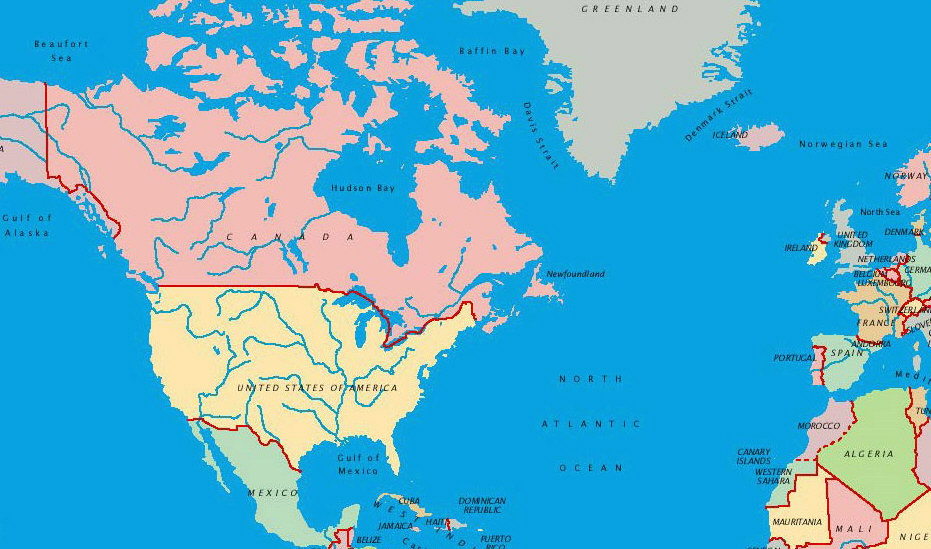
BC, at about 925,000 km2, is more than 10 times the size of Ireland at 70,000 km2. This works out to an average size of roughly 12,00 km2 per riding for BC, more than 7 times larger than Ireland’s constituencies (which are around 1,600 km2 in size). Yet despite the huge increase in riding size BC has way more women elected to representative government, exactly the opposite of the point Tieleman is trying to make in his Georgia Straight article.
It should be obvious that Bill Tieleman is not being very honest in presenting his point of view. It seems evident to me that he has not made his decision about BC-STV based on actual merit but has simply decided from the outset to take a stance against it, and then has just thrown any and all arguments out there with the goal of confusing or deceiving his readers. That should call into serious question his credibility as a commentator on this subject.
Back to Criticisms Mainpage.
Saturday, November 8, 2008
Criticism #2: BC-STV will lead to more minority governments.
This is another common argument presented that switching to BC-STV will lead to more minority governments, with critics trying to paint this apocalyptical picture of never-ending minorities mired in legislative stand-offs with political life being relegated to one long campaign as endless elections, being called every 6-12 months, usurp political discussion.
First off, I’ll start off by saying that, yes, there will be more minorities. And that’s how it should be; it’s pretty rare for a majority of the population to vote for a single party. So if a party only wins minority support in the ballot box, then it should likewise only win a corresponding minority of seats in the House or Legislature. Conversely, a party should be awarded a majority government only if the electorate wants one i.e. a majority of the electorate votes for that party. So when you think about it, the critics’ argument that FPTP is better because it produces more majorities is poor because it has to do so by misrepresenting the votes of the people.
But that’s not the only flaw in their argument. The critics’ assertion that switching to BC-STV will mean more elections because of more minority governments is based on the assumption that minorities under BC-STV will be as unstable as under FPTP. This isn’t true. In the Republic of Ireland, the average life of a minority in the last sixty years has been 3.7 years. Over the same time period Canada and BC, governments have lasted 3.15 and 3.55 years respectively (info courtesy of Antony Hodgson). And don't forget that we have had more majority governments. There is actually a page on the Elections Ireland website that lists the election years along the top. If you take a look, you see that elections actually happen relatively infrequently, with some minority governments even lasting as long as 5 years.
Why is this? Because there is a flaw, inherent to FPTP, that actually provides incentives for politicians to bring down minority governments sooner rather than later. Since STV addresses this flaw, the incentive is removed, leading to longer lasting minority governments.
This flaw, again, has to do with our FPTP system’s failure to produce proportional results; it simply is not cut out to deal with elections where there are more than 2 candidates. Because it is not able to account for vote splitting, margins of victory etc., you have these elections where small changes in the polls can lead to wildly skewed election results.
Let’s take our 2008 federal election as an example.
Stephen Harper and the Conservatives ended up winning 143 seats, a 15% increase from 2006, despite the fact that their share of the popular vote only increased by 1.3% (from 36.3% to 37.6%). On the flip side, Stephan Dion and the Liberals lost 27 seats, a 26% fall from 2006, even though they only dropped 4% in the polls. (wikipedia)
And this is why politicians call elections so frequently under minority governments. Because they know that small changes in public popularity can lead to huge swings in election results. So they wait until the political winds shift ever so slightly in their favour, and then bring down the government, hoping to capitalize on the windfall.
Mr. Harper called an early election for this very reason, banking that the polls would shift just enough to give him a majority. If the polls went in the other direction, you can bet it would be Mr. Dion working to bring down the government.
Now let’s take this scenario and apply it to the context of STV. Under STV, because it is proportional, a small increase in the polls would lead to.... only a small increase in seats won and visa versa. So the Conservatives 1.3% boon would only translate to about an extra 3-4 seats in the House; calling an election wouldn’t have really changed the look of parliament. The incentive has now been removed because public opinion usually doesn’t vary that much so politicians don’t have a reason to call an election since it’s not going to lead to a dramatic shift in power.
Back to Criticisms Mainpage.
Monday, October 27, 2008
Criticism #1: BC-STV is too complicated.
This is by far the most common argument presented against BC-STV and there is some truth to it in that BC-STV is more complicated than the First Past The Post (FPTP) system we use today. This is mostly due to the calculations involved in weighting transfer votes if they are derived from a winning candidate’s surplus votes (in order to adhere to the “one voter-one vote” rule). However, as explained in my “How Does BC-STV Work” post, the underlying principles of BC-STV are fairly straight forward and using it from a voter’s point of view is exceedingly simple. At the bare minimum, all you need to do is write a “1” by a candidate’s name. So all you’re doing is replacing an “X” with a “1”.
But critics will hammer on this point, hoping to scare citizens away from BC-STV despite all the evidence to the contrary.
Ireland has been using this system for 80 years. Scotland has recently used it for the first time in their last national election. Are the Irish and the Scots more intelligent than British Columbians? I don’t think so. But, that’s basically what the critics’ arguments boil down to. We British Columbians, apparently, do not have the mental capabilities of the Irish, Scots, Australians, New Zealanders, Maltans and yes, even Americans who have all used STV somewhere in their respective countries.
Heck, I even remember reading an article (I think it was in the Vancouver Sun) about BC-STV that came out just before the last referendum. It discussed how a teacher had taught her grade 6 class to vote using STV; they voted on what kind of pizza they wanted for lunch. In other words, and lets be very clear on this, this is a system of voting that 11 and 12 year old children have demonstrated an ability to utilize. Are you smarter than a 6th grader? I like to think so. Mr. Tieleman and his ilk do not.
But the fear mongering doesn’t stop there. In the run-up to the 2005 referendum, Tieleman wrote several articles in opposition to BC-STV, an example of one was written for the Georgia Straight in 2004. In it, he writes about how overwhelmingly confusing ballots would be under BC-STV:
Wow, sure sounds scary, doesn’t it? Fortunately, there’s this little thing called reality that gets in the way of their claims.
The thing is when you look at countries that use STV, political parties don’t automatically run full slates; they run the number of candidates depending on how many they expect to elect. So in a 7 member riding, a party like the Liberals or NDP would run only 3-4 candidates (Because they’d only get around 30-40% of the vote, they’d expect to win around 30-40% of the available seats). Small parties like the Green and Marijuana Parties would only run one because they don’t want to split the few votes that they have amongst their own candidates. So instead of having 49 candidates to choose from, as Tieleman would have you believe, based on the parties he listed you would have around 15 or so. (There is another website that tries to twist this fact as another false criticism of STV; I’ll address that as its own point).
You can actually see an example of an STV ballot used in the Irish General Election in 2002 (right click and hit "view image" to take a close-up look at the ballot). If you look closely, you’ll see that there are only 15 candidates listed for the 5-seat riding. Another example of an STV ballot from Australia can be found in wikipedia. In both examples, we find that the claim that voters will be “faced with a very large ballot and dozens of candidates in larger ridings, making it hard to rank the candidates knowledgeably” (knowstv.ca) is unfounded.
But this is a pretty common strategy of STV critics: dream up these wildly remote, hypothetical situations that never happen, hoping to scare people away from making a change.
Back to Criticisms Mainpage.
But critics will hammer on this point, hoping to scare citizens away from BC-STV despite all the evidence to the contrary.
Ireland has been using this system for 80 years. Scotland has recently used it for the first time in their last national election. Are the Irish and the Scots more intelligent than British Columbians? I don’t think so. But, that’s basically what the critics’ arguments boil down to. We British Columbians, apparently, do not have the mental capabilities of the Irish, Scots, Australians, New Zealanders, Maltans and yes, even Americans who have all used STV somewhere in their respective countries.
Heck, I even remember reading an article (I think it was in the Vancouver Sun) about BC-STV that came out just before the last referendum. It discussed how a teacher had taught her grade 6 class to vote using STV; they voted on what kind of pizza they wanted for lunch. In other words, and lets be very clear on this, this is a system of voting that 11 and 12 year old children have demonstrated an ability to utilize. Are you smarter than a 6th grader? I like to think so. Mr. Tieleman and his ilk do not.
But the fear mongering doesn’t stop there. In the run-up to the 2005 referendum, Tieleman wrote several articles in opposition to BC-STV, an example of one was written for the Georgia Straight in 2004. In it, he writes about how overwhelmingly confusing ballots would be under BC-STV:
“the number of candidates (in a seven member riding) would be staggering. If the B.C. Liberal, New Democrat, Unity, Green, Conservative, Reform, and Marijuana parties all ran full slates, there would be a minimum of 49 candidates. Then add any other parties and independents.”
Wow, sure sounds scary, doesn’t it? Fortunately, there’s this little thing called reality that gets in the way of their claims.
The thing is when you look at countries that use STV, political parties don’t automatically run full slates; they run the number of candidates depending on how many they expect to elect. So in a 7 member riding, a party like the Liberals or NDP would run only 3-4 candidates (Because they’d only get around 30-40% of the vote, they’d expect to win around 30-40% of the available seats). Small parties like the Green and Marijuana Parties would only run one because they don’t want to split the few votes that they have amongst their own candidates. So instead of having 49 candidates to choose from, as Tieleman would have you believe, based on the parties he listed you would have around 15 or so. (There is another website that tries to twist this fact as another false criticism of STV; I’ll address that as its own point).
You can actually see an example of an STV ballot used in the Irish General Election in 2002 (right click and hit "view image" to take a close-up look at the ballot). If you look closely, you’ll see that there are only 15 candidates listed for the 5-seat riding. Another example of an STV ballot from Australia can be found in wikipedia. In both examples, we find that the claim that voters will be “faced with a very large ballot and dozens of candidates in larger ridings, making it hard to rank the candidates knowledgeably” (knowstv.ca) is unfounded.
But this is a pretty common strategy of STV critics: dream up these wildly remote, hypothetical situations that never happen, hoping to scare people away from making a change.
Back to Criticisms Mainpage.
Sunday, October 19, 2008
What Are Some Criticisms Of BC-STV? (or Lies About BC-STV from Lying Liars Who Lie A Lot)
There are certain people out there who have taken the stance that British Columbians should not accept the Citizen’s Assembly’s recommendation to accept the Single Transferable Vote (BC-STV). Most of them seem to be from former political insiders or politicians, the most rabid opponent being Bill Tieleman who has his own website, knowstv.ca (get it? k-“no”-w STV? yuk, yuk, yuk, so clever). Incidentally, there is another blogger who has written an excellent rebuttal to Tieleman’s “factual” Q and A section of his website. In his blog post he, point-by-point, dismantles each and every criticism presented by Tieleman and shows the dishonesty inherent in the majority of these arguments.
Now, no one is claiming that BC-STV is perfect and there certainly are legitimate criticisms of it as a system of voting. Unfortunately, perhaps because legitimate concerns are few and hard to come by, the bulk of the arguments are largely derived from half truths, double standards, or just deliberate misrepresentations of the truth. So what are these claims? Let’s take a look at some of the major ones. This post is going to be quite long and I’m going to be adding to it as I go along, so each section will be treated as it’s own essay.
Criticism #2: BC-STV will lead to more minority governments.
Criticism #3: BC-STV will mean less women getting elected.
Criticism #4: BC-STV will mean less accountability and representation from MLAs.
Criticism #5: BC-STV doesn't guarantee proportional results.
Clearing The Mists: A Response To A David Schreck Essay
Now, no one is claiming that BC-STV is perfect and there certainly are legitimate criticisms of it as a system of voting. Unfortunately, perhaps because legitimate concerns are few and hard to come by, the bulk of the arguments are largely derived from half truths, double standards, or just deliberate misrepresentations of the truth. So what are these claims? Let’s take a look at some of the major ones. This post is going to be quite long and I’m going to be adding to it as I go along, so each section will be treated as it’s own essay.
Links to Sections:
Criticism #1: BC-STV is too complicated.Criticism #2: BC-STV will lead to more minority governments.
Criticism #3: BC-STV will mean less women getting elected.
Criticism #4: BC-STV will mean less accountability and representation from MLAs.
Criticism #5: BC-STV doesn't guarantee proportional results.
Clearing The Mists: A Response To A David Schreck Essay
Wednesday, September 17, 2008
Why Change to BC-STV?
You shouldn’t be voting to switch to BC-STV if you don’t have any problems with the following aspects of our political arena:
These are some of the criticisms of our first-past-the-post (FPTP) system and are aspects of elections and voting that really turn people off of politics in general and, in my mind, are significant contributors for the fairly high level of political apathy that we see today.
But what if there was a way to improve upon some, or even all, of these more distasteful facets of politics? Wouldn't you think it'd be worth it to even try? Especially given how important an issue this is; this referendum will have a direct impact on how we are governed as a province.
But can BC-STV really have a positive impact on these more unsavoury elements of our current electoral system? Let's take a closer look.
This fact was highlighted during recent elections here in BC:
With BC-STV, the percentage of seats that a party wins will, as much as reasonably possible, correspond with the percentage of actual votes that they win in an election. The Republic of Ireland is a good example of this and you can see an illustration of this at the Northern Ireland Elections Website which shows the 2007 election results and even shows past results from the 2003 election right underneath (scroll down a bit).
What you’ll notice about the results is how the number of seats won by a party corresponds fairly well with their percentage share of the vote. It’s even closer if you convert the number of seats won into a percentage of the total seats in the assembly, which is a more appropriate comparison anyway.
So, for example, the DUP won 36 seats which are about 33% of the seats in the assembly; they got 36% of the popular vote. The UUP got 18 seats which works out to be a little under 17% of the seats in the assembly; they won 14.9% of the popular vote.
If you continue on across the table, what you find is that the percentage of seats that a party wins in the assembly only differs from their share of the actual vote by around 2-3 percentage points. That’s quite improvement over the 40% difference that the Liberals achieved in 2001.
More accurate elections results that more accurately reflect the desires of the electorate. What a novel concept.
Unfortunately, this, more often than not, seems to be the default mode for many politicians.
But can switching to BC-STV really discourage this type of infantile behaviour? Apparently, it can to some degree. There was an interesting article in the Washington Post that noted how the overall tone of campaigning had improved with the implementation of Instant run-off voting, the single member version of STV:
The same thing was noted in a New York Times article covering the same election:
This is only one example; but it does give one pause to think.
It actually makes sense if you think about it. In any election where you have more than two candidates running, it’s pretty rare for a candidate to win a majority vote in a single round of voting. So for any one candidate to win a majority under STV, they would have to be a second or third choice for an opposition candidate’s voters. That’s unlikely to happen if you’re constantly slagging your opposition or going overly negative on them. You have to become more respectful in your campaigning. I think that would be a refreshing change for voters.
In any election where you have two or more parties of similar political philosophies or policies, you’ll get competition for the same pool of voters, splitting up the collective power of their vote. You can see this happening in our current federal election where the Liberals, NDP and the Green’s are splitting the left of centre vote. This gives an advantage to the Conservative party, who will win the election, not because people really like them, but because the people that dislike them like multiple parties. In fact, because of vote splitting, the Conservatives, or any political party, can win a majority government with only 40% of the popular vote.
What this means is that voters are often left with a choice of voting for not who they truly want, but voting for who they think has the better chance of getting elected (to beat who they dislike). They have to vote against someone as opposed to voting for someone.
BC-STV address this by giving the option for ranking more than one option. So that you can vote for who you truly want, and then rank your alternative choices after that, in case your first choice gets eliminated.
Now I’m not sitting around singing Kumbaya by the campfire with these pie in the sky delusions that simply switching to BC-STV is going to solve all of our grievances with our FPTP system or with politics in general; BC-STV is not a perfect system and never was it claimed to be. But it has been demonstrated to be better and to help improve some of the problems that a lot of us have with our current system. That in itself should be a good enough reason to vote for a change.
- an electoral system that more often than not produces outcomes that misrepresent the actual votes cast in an election.
- mud-slinging and partisan rhetoric dominating political discussion at the expense of mature, civil debate.
- feeling that you are restricted to voting who you think is more likely to get elected, as opposed to voting for who you truly want.
These are some of the criticisms of our first-past-the-post (FPTP) system and are aspects of elections and voting that really turn people off of politics in general and, in my mind, are significant contributors for the fairly high level of political apathy that we see today.
But what if there was a way to improve upon some, or even all, of these more distasteful facets of politics? Wouldn't you think it'd be worth it to even try? Especially given how important an issue this is; this referendum will have a direct impact on how we are governed as a province.
But can BC-STV really have a positive impact on these more unsavoury elements of our current electoral system? Let's take a closer look.
Proportional Representation:
This was the feature of our FPTP system that served as the impetus for the movement toward electoral reform in the first place. One of the most obvious flaws our electoral system is that elections results, with respect to seats won, are not often an accurate reflection of the actual popular vote. In fact, I’d say accurate representation is probably pretty rare.This fact was highlighted during recent elections here in BC:
- such as in 1996 when the NDP won more seats than the Liberals despite the fact that the Liberals won more of the popular vote
- or in 2000, when the Liberals won 97% of the seats in the legislature (77/79 seats) despite winning only 58% of the popular vote
- or the fact that the green party, despite consistently balloting at around 10-15%, never able to get elected to a seat anywhere.
With BC-STV, the percentage of seats that a party wins will, as much as reasonably possible, correspond with the percentage of actual votes that they win in an election. The Republic of Ireland is a good example of this and you can see an illustration of this at the Northern Ireland Elections Website which shows the 2007 election results and even shows past results from the 2003 election right underneath (scroll down a bit).
What you’ll notice about the results is how the number of seats won by a party corresponds fairly well with their percentage share of the vote. It’s even closer if you convert the number of seats won into a percentage of the total seats in the assembly, which is a more appropriate comparison anyway.
So, for example, the DUP won 36 seats which are about 33% of the seats in the assembly; they got 36% of the popular vote. The UUP got 18 seats which works out to be a little under 17% of the seats in the assembly; they won 14.9% of the popular vote.
If you continue on across the table, what you find is that the percentage of seats that a party wins in the assembly only differs from their share of the actual vote by around 2-3 percentage points. That’s quite improvement over the 40% difference that the Liberals achieved in 2001.
More accurate elections results that more accurately reflect the desires of the electorate. What a novel concept.
Political Antagonism:
This is probably the one facet of politics that I dislike the most and if it doesn’t annoy the heck out of you, it should. Political debates should revolve around a mature discussion about the merits of a public policy. If a politician has taken a particular stance on a particular issue, I don’t think it’s unreasonable to expect they be able to defend their position in a rational, mature manner without resorting to partisan rhetoric, mudslinging or character attacks.Unfortunately, this, more often than not, seems to be the default mode for many politicians.
But can switching to BC-STV really discourage this type of infantile behaviour? Apparently, it can to some degree. There was an interesting article in the Washington Post that noted how the overall tone of campaigning had improved with the implementation of Instant run-off voting, the single member version of STV:
“Advocates said the new system has made campaigning more civilized -- candidates don't want to lose out on the chance to be a voter's second or third choice by appearing too negative”
The same thing was noted in a New York Times article covering the same election:
"An early effect has been to introduce a new civility among the candidates, something many San Franciscans have wholeheartedly embraced. Because the winner in each district might be determined by voters' second and third choices, candidates have quickly learned that it is best to be on friendly terms so as not to alienate their opponents' supporters."
This is only one example; but it does give one pause to think.
It actually makes sense if you think about it. In any election where you have more than two candidates running, it’s pretty rare for a candidate to win a majority vote in a single round of voting. So for any one candidate to win a majority under STV, they would have to be a second or third choice for an opposition candidate’s voters. That’s unlikely to happen if you’re constantly slagging your opposition or going overly negative on them. You have to become more respectful in your campaigning. I think that would be a refreshing change for voters.
Voter Choice:
This is just my opinion; but from hearing people talk, this strikes me as being one of the biggest reasons for voter apathy. It’s understandable; it’s hard to get excited about voting if you feel that your vote will just go to waste. But this is in part due to a weakness inherent to the FPTP system, vote splitting.In any election where you have two or more parties of similar political philosophies or policies, you’ll get competition for the same pool of voters, splitting up the collective power of their vote. You can see this happening in our current federal election where the Liberals, NDP and the Green’s are splitting the left of centre vote. This gives an advantage to the Conservative party, who will win the election, not because people really like them, but because the people that dislike them like multiple parties. In fact, because of vote splitting, the Conservatives, or any political party, can win a majority government with only 40% of the popular vote.
What this means is that voters are often left with a choice of voting for not who they truly want, but voting for who they think has the better chance of getting elected (to beat who they dislike). They have to vote against someone as opposed to voting for someone.
BC-STV address this by giving the option for ranking more than one option. So that you can vote for who you truly want, and then rank your alternative choices after that, in case your first choice gets eliminated.
Now I’m not sitting around singing Kumbaya by the campfire with these pie in the sky delusions that simply switching to BC-STV is going to solve all of our grievances with our FPTP system or with politics in general; BC-STV is not a perfect system and never was it claimed to be. But it has been demonstrated to be better and to help improve some of the problems that a lot of us have with our current system. That in itself should be a good enough reason to vote for a change.
Friday, September 12, 2008
What is BC-STV?
BC-STV is basically the BC version of the Single Transferable Voting (STV) system, which is a form of preferential voting. It was designed to produce proportional representation meaning that the results of an election, i.e. seats won, would more closely mirror the percentages of votes cast. Another design goal is to ensure that election winning candidates do so with a majority vote, more accurately reflecting voter preferences.
The recommendation to switch to this system of voting from our current system (known as plurality voting) was first made by the Citizen’s Assembly on Electoral Reform. The decision to accept this recommendation was put to a referendum during the last provincial election in 2005. Unfortunately, it failed to get the required supermajority (60%), missing by only 2%. However, it can be argued that this was largely due to a lack of awareness as a lot of people went to the voting booth either not really understanding STV or not even being aware that a referendum was being held.
The good news is that because of the close result, we will be having another opportunity to vote on this very important issue. Hopefully, we’ll be able to use the time to raise awareness about STV as it has been consistently shown that when people who are introduced to STV and feel that they understand it, the vast majority of them are willing to vote for it.
Subscribe to:
Posts (Atom)


